

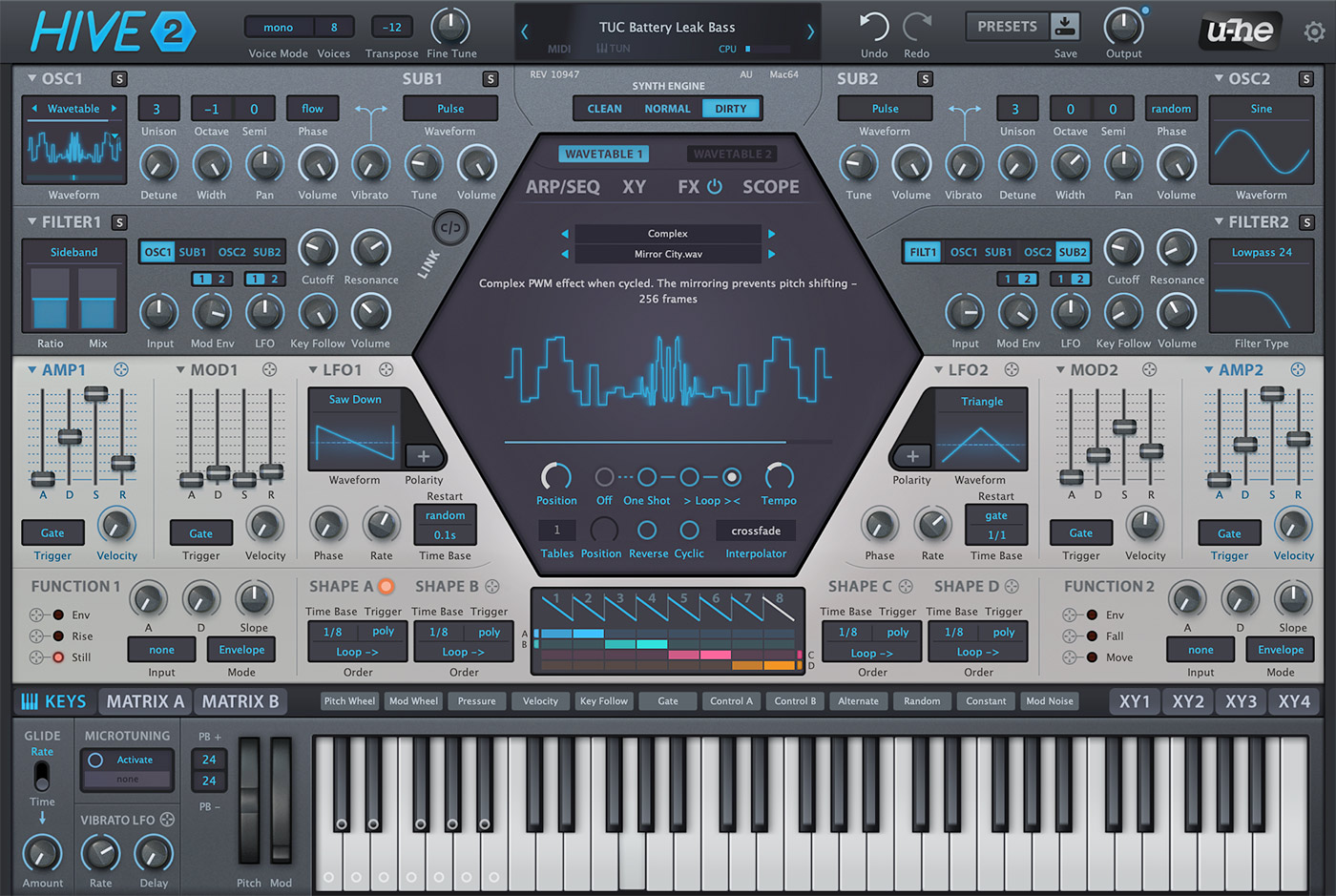
u-he HIVE 2 VST Synth Plug-in
Original price was: $160.00.$70.00Current price is: $70.00.
ℹ️ New to ReverBay? Learn how it works →
u-he HIVE 2 VST Synth — 3 engines, 2,400+ presets, 16x unison & deep modulation. NKS-ready. PC & Mac. VST2/VST3/AU/AAX.
u-he HIVE 2 VST Synth — Fast, Flexible, and Deeper Than It Looks
The u-he HIVE 2 VST Synth was built around a simple idea: give producers access to a powerful, expressive synthesizer that doesn’t slow down the creative process. Three synth engines, two oscillators with 16x unison, 2D wavetable support, and over 2,400 factory presets — all inside an interface that stays out of your way.
Beginners can load a preset and start making music immediately. Experienced producers can dig into the modulation matrix, XY pads, and shape sequencer and find as much depth as they need. That range is what makes HIVE 2 worth considering for any production setup.
u-he HIVE 2 — Engines and Oscillators
Core Synthesis Features
- 3 Synth Engines — covers wide sonic variety from clean to complex
- 2 Oscillators with 16x Unison + sub oscillators for dense layering
- 2D Wavetable Support for evolving, morphing tones
- 2,400+ Factory Presets — all NKS-ready for Native Instruments hardware
- Improved CPU performance in version 2.1.1 for smoother sessions
Modulation & Control
- Drag-and-drop modulation routing — no menu diving
- 12 x 2 Mod Matrix Slots with Curvature, Rectification, Sample & Hold, and Slew Rate modifiers
- 4 XY Pads for expressive macro control in real time
- 8-Step Shape Sequencer with 4 independent outputs
- 2 Function Generators (LFO, envelope, gate modes)
Performance and FX Tools
HIVE 2 includes an arpeggiator and real-time step sequencer for rhythmic and melodic pattern generation. A Scale Quantizer keeps notes in key automatically, which speeds up melodic work considerably. The Audio Scope lets you visualize output and modulation behavior directly in the interface — useful when you’re fine-tuning complex patches.
Seven rearrangeable FX units cover the standard signal chain: Distortion, Chorus, Delay, Phaser, EQ, Reverb, and Compressor. You can reorder them to match your processing preference, and they’re all available from the same page without extra navigation.
Interface and Integration
The UI scales from 70% to 200%, so it adapts cleanly to high-resolution monitors or smaller setups. An alternative Izmo skin ships with HIVE 2 if you prefer a different visual style. Microtuning support via .tun files and Oddsound MTS-ESP compatibility are included for producers working with non-standard tuning systems. Panel Presets let you save and recall settings for individual modules — oscillators, LFOs, FX — independently from the full patch.
🛒 Get u-he HIVE 2 VST Synth
3 Engines · 2,400+ Presets · NKS Ready · PC & Mac
Why HIVE 2 Works for So Many Producers
HIVE 2 covers a lot of ground without making you work hard to access what you need. The preset library alone gets you deep into pop leads, EDM pads, cinematic textures, and bass sounds — and since presets are NKS-ready, they integrate with Komplete Kontrol and Maschine hardware automatically.
For producers who want to go beyond presets, the modulation system is genuinely deep. The 12 x 2 mod matrix with per-slot modifiers means you can route complex modulation paths that wouldn’t be possible on simpler instruments. The XY pads bring that expressiveness into live performance or automation without requiring external controllers.
Browse more synthesizer plugins at ReverBay, or visit u-he’s official HIVE 2 page for detailed technical documentation.
Frequently Asked Questions
Is HIVE 2 compatible with Apple Silicon Macs?
Yes. u-he provides native Apple Silicon support for HIVE 2. Check u-he’s official site for the latest compatibility details on your specific macOS version.
What DAWs does HIVE 2 support?
HIVE 2 supports VST2, VST3, AU, and AAX formats, covering all major DAWs including Ableton Live, Logic Pro, FL Studio, Cubase, Pro Tools, and Reaper on both PC and Mac.
What does NKS-ready mean?
NKS (Native Kontrol Standard) means HIVE 2 presets integrate with Native Instruments Komplete Kontrol keyboards and Maschine, giving you full preset browsing and parameter mapping directly on the hardware.
What is the 2D Wavetable support in HIVE 2?
2D Wavetable support lets you import and use wavetables that can be scanned on two axes simultaneously, producing more complex and evolving tonal movement than standard single-axis wavetable scanning.
Related products
VST Instruments
VST Instruments
VST Instruments

VST Instruments
VST Instruments

VST Instruments
VST Instruments
VST Instruments